Showing posts with label home and garden. Show all posts

27 February, 2011

Frangipani - "Queen Napranum"


Australian frangipani growing history varied and colorful, just like the plants themselves. In the late 19th and early 20th centuries in Australia's top end, Christian missionaries coming mainly from Samoa and Vanuatu, established mission settlements for the local Aborigines. They brought with them their favourite sacred frangipanis for planting around the missions.

Although the missions were finally abandoned, old mango trees, coconut palms and frangipanis have survived, despite cyclones, prolonged droughts and frequent bush fires. This cultivator, "Queen Napranum" was discovered growing wild at an abandoned Samoan-run mission in Top End country. Cuttings from these trees were taken in early 1920's and these days one can see many "Queen Napranum" trees in Australian gardens. This variety have great drought resistance and incredible vigor.

Imagine my delight when I spotted this tree on my early morning walk! Knowing it's history, I just had to take a picture and to admire it's special and beautiful colorful blooms.
The sun was just about to come out and this frangipani's aroma was strong peach scent - heady and intoxicated! They say that "fragrance lies in the nose of the inhaler", of course, I agree and with so many varieties of frangipanis - what a sweet opportunity for investigation!

29 January, 2011

Memory and Frangipani Perfume


Science tells us that the sense of smell is somehow linked to memory and emotions because it is processed in the same part of the brain. Aromas trigger associations - suggesting, exiting, disturbing, etc, and our reactions to scents can be quite personal.

Up until the 1920's, single flower essences were most common in commercial perfumes. Blends were just becoming possible and extraction methods and "fixing" of fragrances were being developed.
It has been said that a perfumer, using natural talents and very high skills, blends selected ingredients much as a composer combines instruments of an orchestra and most perfumes today are complex blends of ingredients, including synthetic equivalent as a foundation.

In 1991, a team of Japanese researchers collected almost 500g ( 1 pound) of flowers from each of the two frangipani varieties - the common white/yellow "Celadine" and dark red variety "Irma Bryan". They subjected flowers to steam distillation and produced a miniscule 70 milligrams ( 0.002 ounces) of frangipani essential oil. This oil was then further subjected to tests by spectrometry and chromatography that reveal that each cultivar had it's unique oil composition, white/yellow "Celadine" being very different to that of the red "Irma Bryan".

Naturally, making frangipani perfume using traditional techniques of extractions makes very expensive product - this is reflected in the pricing and the best is sold as "frangipani absolute".

Not long ago I remember reading about a survey of available perfumes worldwide - interestingly, only a couple of them contain pure frangipani oil. "Coco" by Chanel contains frangipani in it's ingredients and "Narcisse" by Chloe have Plumera rubra as it's dominant note.

For many people, frangipani flower fragrance is the most important feature and the plant itself sealed the popularity of frangipani's forever.

PS - spotted this beauty the other day on my early morning walk - her scent was strong honeysuckle - heaven!

13 June, 2010

Frangipani Seedpods


Here in AU we are in the beginning of winter and some of my frangipani trees developing seedpods. The one in the picture is from my very nice pink flower frangipani.

For any gardener with impatient disposition like me growing frangipani's from seed is a long drawn-out process, but having said this, many wonderful new varieties been developed by people who are prepared to give it a go and see what Mother Nature can came up with.
We all know that the only sure way to guarantee a variety that is "true to type" is to propagate frangipani's by vegetative means - eg cuttings, grafts or tissue culture.

However, it is from seedlings that new and unusual varieties are developed, so if one prepared to spend time and a bit of efforts, one can be rewarded with raising a variety so outstanding, it will make a world a more beautiful place, and in my mind the world needs a few more beautiful heavenly scented frangipanis. One may even get bitten by the "bug" and start exploring fine skill of collecting and transferring pollen to create true frangipani magic.

The seedpods will mature on the tree for a few months and then can be split-open to reveal approx 100 seeds which can be planted in a seed-raising mix. The seeds themselves can be viable for up to three years, so its possible to store them for a while in cool, dry and dark conditions, waiting for the right time to saw them. Some people sow them in seed raising trays and others into individual tubes. Whatever you use, make sure they are well labelled.

Young seedlings will need care and attention and provided with enough moisture and fertilizer to get them going, protected from harsh sun and colder weather. There will be of course some loss but the one's that survive will flower in it's third year. All flowered seedlings will be extremely variable in color, size and shape as well as the plant habit and vary from compact growth to lanky and willowy.

This way you may create a wonderful new variety, never seen before with beautiful scent and appearance, a combination of certainty and enchantment!

"Just living is not enough! One must have sunshine, freedom and a little flower".
Hans Christian Andersen


01 May, 2010

Frangipani - "White Shell"


When one speaks of frangipani colors, there is an understanding that one deals with the huge variations worldwide. For instance, seedlings raised from natural pollinations will display staggering variety in colors and textures of flowers and cultivars, which been especially selected by breeders will display huge variations of colors and beauty.
From whites to creams and all shades of yellow, through gold, apricot, orange, pinks and reds, frangipanis delight people with their flamboyance - there is a flower to suit every taste.

This beautiful frangipani currently in flower in my garden aptly named "White Shell" - it's petals curl in same pattern and it have the most heavenly jasmine scent thats more intense in the evenings. Friend gave me a cutting of "White Shell" many years ago in exchange for some orchid and I cherish this plant for it's pristine beauty and many happy memories.

17 April, 2010

Frangipanis - The Origins


Many people assume that frangipanis originated in Asia, especially when so many of these beautiful trees found in huge numbers around temples, flowers offered to Buddha as offerings and in some parts of India the frangipani represents eternity because of it's remarkable capacity to continue flowering well after the branch has been picked.

But actually, records indicate that frangipanis were unknown in the East before the sixteen century, when Portuguese and Spanish traders introduced the specimens plants they had collected from various parts of the New World and the Caribbean.

Frangipani plants are actually native to the semi-deciduous forests of southern Mexico and Panama and first were featured in The Badianus Manuscripts of 1552. It's an earliest collection of Aztec herbal remedies that was compiled during early years of Spanish rule, that shows that indigenous people used frangipani for a wide range of medicinal purposes. This hardy shrub with beautiful fragrant flowers became the favourite of the Spanish, who planted it around their churches, monasteries and took it with them as they explored the world.

For thousand of years frangipanis were cultivated in the area of present-day Mexico and in Aztec and Mayan civilisations frangipani was known as Cacalo. Mayans believed that the flower was created by the father of the gods, and it was intrinsically woven into their mythology. It was a sacred symbol of truth and immortality.

From the sixteen century frangipanis were taken from the New World to the Old and ultimately spread to world's tropical islands and when tourism took off in the twentieth century, frangipanis were quickly adopted as a symbols of a relaxed tropical lifestyle.

03 April, 2010

Frangipani - "Love Lane Pink"


While visiting one of my friends late in the afternoon, I've spotted this beautiful frangipani growing on the side of the road and just had to take this picture of its flowers.

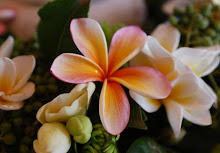
It's one of the world-loved varieties called "Love Lane Pink" and it flowers with these rich color pastel pink blooms that go deeper and more intense as the flower matures. The flowers are quite full and large and seems like changing color depending on the light, showing it's color spectrum in white, yellows, pale and deep pinks with a touch of burgundy at the end of the petals.

As I was taking the pictures, being late in the afternoon, it's started releasing it's scent - sweet perfume reminiscent of coconut, no doubt, getting ready for night blooming. The perfume of tropical frangipanis always more intense at night and because of it, many people plant them under the windows or near the balconies or verandas to be able to smell their delicious fragrance.

"Love Lane Pink" variety is one of the very special frangipani, loved and grown in many tropical and sub-tropical gardens around the world for it's magical blooms and scent.


26 March, 2010

Frangipani - different colors

The colors of frangipanis are so diverse and so stunning in their appearance and texture and scent, they appeal to many people. With so many varieties to choose from, I am sure everyone will have a favorite plant, or two. The pinks, the yellows, the whites, the reds, the purples - what a beautiful color spectrum!
Below is the video featuring collection of frangipani plants from the tropical island of Sulawesi in Indonesia and a great introduction to these magical plants.